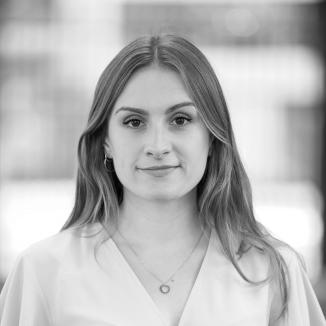
Monika De Ridder (Grzegorczyk)
Monika worked at Bruegel as a Research Analyst until August 2022. Monika is completing her second master’s degree in Models and Methods of Quantitative Economics at Paris 1 Pantheon Sorbonne and UCLouvain. She holds a BSc in finance and a MA in Political Science. Her research interests include monetary policy, financial regulations, and structural reforms.
Prior to Bruegel, Monika worked as a Junior Economist at OECD on the qualitative and quantitative assessment of the implementation of structural policies and recommended actions. She was able to apply new machine learning methods such as Natural Language Processing for textual analysis.
Monika was a trainee at governmental bodies (the Polish Finance Ministry, Ministry of the Interior and Administration, and the Polish delegation to OECD) and worked for non-governmental organisation (Foundation Institute for Strategic Studies). She also gained her experience through research assistance at the Paris School of Economics on Macroeconomic imbalances procedure (published as European Parliament Study).
Featured work

European Union countries’ recovery and resilience plans

Greeniums in sovereign bond markets
In this paper, we analyse whether green sovereign bonds are systematically priced differently to conventional sovereign bonds in the secondary markets

Cross-border telework in the EU: fab or fad?
Europe should investigate the possibility of ‘digital frontier worker’ status for cross-border remote workers.

Closing the gender gap for self-employed women in the European Union
Self-employed women are at a wealth disadvantage, according to ECB household finance data, and thus have more to gain from policies that spur saving.

Measuring macroeconomic uncertainty during the euro’s lifetime
We draw out four indicators of macroeconomic uncertainty, measured over the lifetime of the euro.

The decoupling of Russia: European vulnerabilities in the high-tech sector
The EU will face challenges in sectors where it relies on Russian and Ukrainian commodities and technologies.

The decoupling of Russia: high-tech goods and components
Sanctions on high-tech goods supplies, combined with financial sanctions and other restrictions, will deprive Russia of a future as a modern economy.

Better pensions for the European Union’s self-employed
What is the current state of pensions policy in Europe and how are independent workers treated compared with their traditionally employed counterparts

The risks for Russia and Europe: how new sanctions could hit economic ties
To play a deterrent role against Russian military action, sanctions would have to be very broad, have a rapid effect and be as coordinated as possible

Is the risk of stagflation real?
Most economic forecasts predict a return, in the medium-term, to pre-pandemic growth and inflation. Nevertheless, the European Central Bank and fiscal

Don't let up - The EU needs to maintain high standards for its banking sector as the European economy emerges from the COVID-19 pandemic
In-depth analysis prepared for the European Parliament's Committee on Economic and Monetary Affairs (ECON).

Blending the physical and virtual: a hybrid model for the future of work
The pandemic has shown that many workers can efficiently work remotely, with benefits for wellbeing and even productivity.

The impact of COVID-19 on the Internal Market
Study assessing the impact of the COVID-19 crisis on the European Union's Internal Market and consumer protection prepared for the European Parliament

The scarring effect of COVID-19: youth unemployment in Europe
Even before the pandemic, youth unemployment in the European Union was three times higher than among the over-55s. COVID-19 threatens to undo the last