Hungary’s path to the euro: five tests for a sustainable adoption strategy
Hungary’s euro ambitions require fiscal and institutional repair first, as the formal criteria can mask budget, credit and competitiveness weaknesses

Executive summary
The Hungarian government elected in April 2026 supports euro adoption and aims to meet the adoption conditions around 2030. For adoption to happen, certain criteria must be met, but these can mask fiscal weakness, credit booms and competitiveness losses that become harder to correct without national monetary and exchange-rate policies.
We propose five domestic readiness tests for the Hungarian government to consider in its euro-adoption strategy. These would help assess whether Hungary’s institutions, policies, productive capacity, shock absorbers and proposed forint-euro exchange rate will be sufficiently ready for it to prosper within the euro area, while identifying the necessary reforms and sequence.
In a context of a budget deficit near 7.3 percent of GDP, high debt-service costs, weak productivity and price and credit distortions, institutional repair and fiscal consolidation should come first. Consolidation should redirect resources from poorly targeted subsidies, low-return investment and politically directed support towards health, education, research and infrastructure. Price and credit distortions should be phased out or retargeted, monetary transmission restored and wage growth aligned with productivity. Entry into the Exchange Rate Mechanism should wait until the fiscal and inflation paths are credible. The central exchange rate should be consistent with long-term competitiveness and robust against major shocks. A strong exchange rate should not be used to meet the inflation criterion.
The adjustment will take several years. Alongside these reforms, euro adoption could strengthen credibility, investment and income convergence. Premature entry would risk weak growth, renewed inflation and a painful adjustment inside the currency union.
1 Introduction
Hungary’s government, elected in April 2026, has said it wants to meet by 2030 the criteria for joining the euro – the ‘Maastricht criteria’ from the city where the EU treaty was concluded in 1992 (Box 1). Actual adoption of the single currency by Hungary would then follow at an unspecified future date1. With about 80 percent of Hungarians supporting adoption, and financial markets responding favourably to the government’s plans, the political and economic circumstances are unusually supportive.
Euro membership would eliminate exchange rate risk vis-à-vis other euro countries, reduce transaction costs, increase price transparency and give Hungary a voice in European Central Bank decision-making. Lower currency and sovereign risk premia could also reduce borrowing costs and support investment and growth. Greater policy credibility might benefit economic development. However, membership would remove national monetary and exchange-rate policies as instruments of adjustment, placing greater demands on fiscal policy, wage and price adjustment, financial resilience and productivity.
In terms of macroeconomic performance, euro-area membership in itself is neither necessary nor sufficient for success: various European Union countries have performed both strongly and weakly both inside and outside the euro area (Darvas, 2019). The relevant question for Hungary is whether it can prepare itself to prosper after euro adoption, particularly in an environment shaped by war, energy insecurity, Chinese competition and climate change.
The Maastricht framework determines whether a country qualifies to adopt the euro but does not guarantee successful economic performance thereafter. A government can meet the numerical criteria temporarily while carrying fiscal liabilities, wage pressures or an exchange-rate misalignment that complicate macroeconomic performance after entry. For example, Portugal, one of the first eleven countries to adopt the euro in 1999, experienced particularly weak growth after adoption, a development that has been linked to an overly appreciated conversion exchange rate (Darvas and Szapáry, 2010).
Furthermore, even when the euro conversion rate is chosen appropriately, an economy may subsequently struggle to adjust to adverse shocks. The euro-area crisis in the early 2010s showed that fulfilment of the Maastricht criteria before euro adoption was not sufficient to ensure sustained macroeconomic stability and successful adjustment within the euro area. However, a government can improve the preparedness of the economy before joining the euro area and meeting the formal entry criteria.
In this Policy Brief, we propose five domestic readiness tests for Hungary to identify the necessary reforms and their sequence. The five-test format echoes a framework used by the UK Treasury in 1997 (Potton and Mellows-Facer, 2003). In this paper, however, the tests are conditions for implementing a declared objective of euro adoption, rather than criteria for deciding whether to join. The tests assess whether Hungary can meet the EU Treaty requirements in a way that will enable its economy to function successfully within the euro area.
Our proposed five tests provide a framework for improving institutions, restructuring the public finances, fostering a durable low-inflation environment, improving productivity and selecting a sustainable exchange rate. They also consider whether fiscal policy, wage setting and the financial system can manage shocks after national monetary and exchange-rate policies have been relinquished. Euro adoption can reinforce the proposed reforms by raising the economic and political cost of reversing them, but that credibility benefit depends on sound institutions and a sustainable entry rate (Giavazzi and Pagano, 1988).
Box 1: Formal euro adoption criteria
Article 140 and Protocol 13 of the Treaty on the Functioning of the European Union (TFEU)2 govern the procedure for evaluating whether an EU country with a derogation (countries that do not yet use the euro) fulfils the conditions required to adopt the euro. Four formal convergence criteria must be satisfied: price stability, long-term interest-rate convergence, a sustainable fiscal position reflected in the absence of an excessive deficit procedure, and participation in Exchange Rate Mechanism II (ERM II – a fixed exchange rate system with a +/- 15 percent wide fluctuation band) for at least two years without severe tensions.
In addition, the TFEU requires an assessment of market integration, developments in the balance of payments and trends in unit labour costs and other price indicators, although no explicit numerical benchmarks are specified for these factors. National legislation, in particular the statute governing the central bank, must also be compatible with the relevant provisions of the TFEU and the Statute of the European System of Central Banks and of the European Central Bank.
At least every two years, or at the request of an EU country with a derogation, the European Commission and the ECB evaluate the progress made by the euro-area candidate countries. They publish their conclusions in convergence reports3.
The distinction between the formal Maastricht criteria and the five domestic readiness tests proposed in this paper should inform Hungary’s dialogue with the European institutions. Hungary should seek an early technical roadmap covering legal alignment, preparation for the exchange-rate mechanism (ERM II), close cooperation with ECB banking supervision, payment systems and the convergence-assessment timetable. While European support can facilitate accession within the existing rules, it cannot substitute for credible domestic reform. Even if compliance with the Maastricht criteria appears within reach, we do not advocate rapid euro adoption unless the five domestic readiness tests are also met in a convincing and sustainable manner.
Section 2 outlines Hungary’s initial position, followed by the presentation of our five tests and our evaluation of the country in section 3. Section 4 suggests the sequence of the adjustment process. Finally, section 5 provides concluding remarks.
2 Hungary’s starting position
2.1 Low potential growth and weak productivity
The Hungarian government’s most concerning economic inheritance is low productivity growth, which slowed markedly over about the last fifteen years. Labour productivity growth averaged 3.6 percent from 2001 to 2008, 1.1 percent from 2011 to 2019 and 0.4 percent from 2022 to 20254. Weakened productivity growth can be attributed to several factors: the erosion of human capital due to shortcomings in education at all levels, reduced competition resulting from regulatory measures and increased state ownership, the misallocation of substantial EU transfers received by the country and the inability to strengthen the country’s weak capacity for innovation5.
Weak productivity growth constrains tax-base growth and limits the rate at which wages can rise without generating inflation or weakening competitiveness. It also makes fiscal adjustment more difficult. The balance required to place public debt on a declining path depends on the initial debt stock and the real interest-growth differential, not simply on reducing the deficit below three percent, as required by EU rules – which, in fact, might not be sufficient even for euro entry (see test 2 in section 3.2). With public debt at about 79 percent of GDP in 2026, still high borrowing costs and weak trend growth, Hungary needs a fiscal path that will reduce debt while retaining room to absorb adverse shocks. The International Monetary Fund’s October 2026 World Economic Outlook does not yet envisage such an outcome, projecting a continued increase in Hungary’s public debt-to-GDP ratio throughout the forecast horizon, reaching 88 percent by 2031 (IMF, 2026).
2.2 A distorted fiscal structure
The headline deficit is expected to be around 7.3 percent of GDP in 2026 (IMF, 2026), close to pandemic-era levels. The composition of the budget is a deeper problem. Hungary’s public services are underfunded, while the state spends heavily on subsidies, interest support, politically directed investment and administration (Darvas, 2026). Tax exemptions have narrowed the personal income tax base and pension commitments have increased without a clear long-term financing plan. Household energy price controls suppress measured inflation while imposing a fiscal cost and weakening incentives to conserve energy (European Commission, 2026; IMF, 2025).
Rather than squeezing spending indiscriminately, Hungary should rebalance expenditure. It should reduce poorly-targeted subsidies and low-return economic support, broaden the tax base and redirect some of the savings towards education, health, research, transport and municipal services. Higher spending in these areas should be accompanied by improvements in procurement, project appraisal and service delivery.
2.3 A stronger external position, but an appreciating real exchange rate
The strongest part of the government’s economic inheritance is Hungary’s external position. The current account surplus means that the economy is not presently reliant on net foreign borrowing. Gross external debt is high, but this overstates the immediate foreign currency vulnerability because it includes forint-denominated liabilities and relatively stable intercompany debt. The foreign-currency component of external debt and the net foreign-currency position are materially smaller than the headline gross figure. The external accounts therefore do not currently point to a need for abrupt adjustment, even if refinancing and investor confidence risks remain (IMF, 2025).
Figure 1: GDP per capita and relative price level, EU countries (% of eight advanced EU countries)
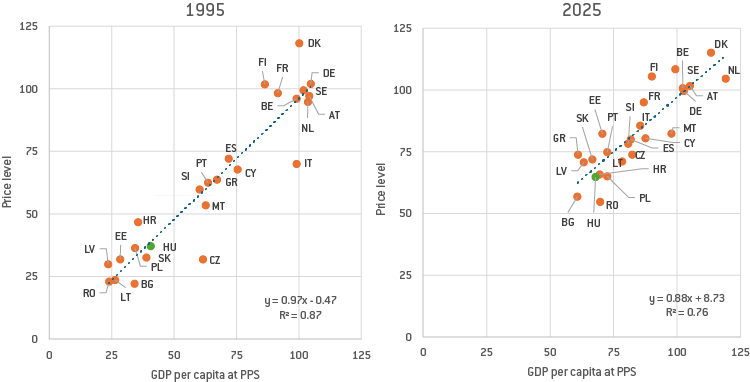
Source: Bruegel based on May 2026 AMECO dataset. Note: the GDP-weighted average of eight advanced EU countries is set equal to 100 for both the price level and GDP per capita at purchasing power standards (PPS), because this is the group with which less-developed EU countries should aim to converge. The comparator comprises Austria, Belgium, Denmark, Finland, France, Germany, the Netherlands and Sweden. Ireland and Luxembourg are excluded because of their special economic structures.
The current-account surplus partly reflects weak domestic demand and could narrow quickly as consumption and investment recover. The CPI-based real effective exchange rate (REER) appreciated 8.8 percent over the year to July 2026 to 14 percent above its 25-year average. While the corresponding deviations were larger in the comparable countries of Czechia (29 percent), Poland (20 percent) and Slovakia (18 percent), the pace of recent Hungarian appreciation might be a cause for concern6. Moreover, in terms of unit-labour-cost-base REER, Hungary experienced an 18 percent real appreciation in 2026Q2 compared to a year earlier, while the 2026Q2 value was 25 percent above its 25-year average, similarly to Czechia (23 percent), but higher than in Poland (15 percent) and Slovakia (17 percent).
Figure 1 shows where Hungary’s income and price levels sit within the EU – close to the cross-country regression line both in 1995 and in 2025. In 2026, Hungary’s position will likely be above the regression line because of exchange-rate appreciation. The combination of weak productivity growth and rapid real appreciation warrants caution. Appreciation can suppress imported inflation and make nominal convergence easier, while weakening domestic suppliers and future external performance7.
2.4 Institutional repair and a changing tradable sector
Hungary must restore the practical independence of its central bank (Magyar Nemzeti Bank, MNB). The MNB is legally independent and direct monetary financing is already prohibited, but steps must still be taken to align legislation on the bank with the requirements of the European System of Central Banks and establish a record of decisions that is visibly insulated from the government of the day. The treatment of the MNB’s negative equity and future profits should be resolved transparently with the fiscal authorities and the ECB (European Commission, 2026; ECB, 2026).
The structure of exports is also changing. Foreign direct investment into manufacturing remains important, including large investments in electric vehicles and batteries, but this risks creating overspecialisation, rising fiscal and environmental costs, resource pressures and geopolitical exposure with limited domestic embeddedness and modest local value added (Győrffy, 2024; Csontos et al, 2026). Chinese investment should not be presumed either beneficial or harmful on the basis of nationality alone. It should be assessed against domestic value added, local procurement, research content, imported labour and inputs, public subsidy, energy use, environmental impact, profit repatriation and exposure to EU trade policy. The weakness of Germany’s industrial cycle – into which Hungarian manufacturing is deeply integrated – and the China export shock make diversification and local supplier development more urgent (Kratz et al, 2025; European Commission, 2025; IMF, 2025).
3 Five domestic readiness tests
We propose five domestic readiness tests for Hungary as follows.
3.1 Test 1: institutional readiness
Can Hungary put in place the legal and public institutions needed to prepare for euro adoption and to sustain membership?
The European Commission and the government of Péter Magyar agreed in May 2026 to release to Hungary EU funds that had been frozen over rule-of-law problems that arose under the previous government of Viktor Orbán8. This was an important step in restoring EU-Hungary relations. However, it does not complete the institutional work required for euro adoption. The Commission’s June 2026 Convergence Report on how closely aligned non-euro countries are with the euro adoption criteria identifies outstanding issues in the legislation on the MNB. Beyond legal compatibility, the government needs reliable medium-term budgets, effective scrutiny of fiscal risks and the capacity to turn public spending into productive investment (European Commission, 2026; ECB, 2026)9.
Current judgement
Hungary has made progress on rule of law and meeting EU funding conditions, but its institutions are not yet ready for the euro. The government should establish which legal issues remain outstanding following reforms already enacted, agree a timetable for addressing them in consultation with the ECB, and demonstrate that the fiscal and administrative reforms can work in practice.
Priorities
- Amend the MNB legislation to protect the bank’s independence, clarify its financial position and enable its integration into the Eurosystem;
- Give the Fiscal Council of Hungary10 sufficient capacity to assess forecasts and fiscal risks;
- Publish a fuller account of guarantees and other commitments outside the annual budget;
- Apply independent appraisal and evaluation to major public investments, whether funded domestically or by the EU.
Preparation for European banking supervision should proceed in parallel. Institutional renewal also requires a personnel strategy that retains technical expertise, strengthens merit-based recruitment and pay in specialist functions, and draws selectively on the Hungarian diaspora, EU institutions and temporary external secondments.
3.2 Test 2: a sustainable fiscal transition
Can Hungary put public debt on a credible declining path and meet the fiscal criterion through durable restructuring rather than temporary measures, optimistic growth assumptions or anticipated market gains?
Hungary must do more than reduce the deficit below three percent of GDP. It must also comply with the Council of the EU-endorsed net-expenditure path and place debt on a credibly declining trajectory, which requires an overall deficit of roughly one percent to 1.5 percent of GDP by 2030 or 2033, depending on whether the country’s new medium-term fiscal-structural plan covers four or seven years. Hungary is subject to deficit-based excessive deficit procedure (EDP), and this might be closed once the deficit falls below three percent. However, if the Council-endorsed fiscal path is not respected in subsequent years, a debt-based EDP might be opened (prohibiting euro adoption) and EU budgetary funds might be suspended, though neither decision is automatic11.
A one to 1.5 percent deficit would also provide a useful fiscal buffer after euro adoption. Fiscal policy would then be Hungary’s principal instrument for responding to country-specific shocks that do not warrant a change in ECB monetary policy. The appropriate endpoint should therefore reflect both debt sustainability and the need to preserve room for automatic stabilisers and, where necessary, discretionary support.
The strategy should concentrate first on measures that improve both the budget and resource allocation. These include reducing poorly targeted investment and interest subsidies; replacing universal household energy subsidies with support targeted at the most vulnerable; lowering procurement overpricing and political communication expenditure; reviewing support for sectors with weak social returns; protecting the thirteenth month payment for lower pensions, while potentially capping it at a rate equivalent to the average pension, and halting a planned expansion to a full fourteenth month; reforming tax-free savings vehicles; and introducing at least a moderate progressivity into the personal income tax system (OECD, 2026) while narrowing exemptions, with protection for lower-income families. Broader wealth taxation, beyond the envisaged partial levy on forint billionaires12, would at least partially compensate for the lack of taxation of capital gains from real estate and long-term savings accounts, from which poorer segments of society benefit little. Broad VAT cuts should be avoided because they are costly, weakly targeted and only partly passed through to prices13.
The same programme should redirect spending to health, education, research, transport, energy security and effective local government. This is a fiscal reallocation as well as a consolidation. It will be politically difficult because many of the savings are concentrated on visible beneficiaries, such as pensioners and the current beneficiaries of universal household energy support, while the gains from stronger public services arrive gradually. A multi-year expenditure review, independent costing and annual publication of implementation results are therefore essential.
Market tailwinds should be treated conservatively. Pursuing a credible path to euro adoption should compress sovereign yields but the budget benefit will appear only as debt rolls over and could reverse if the programme loses credibility. EU funds can raise public investment and confidence, but should not finance permanent current spending or substitute for domestic consolidation. Private capital inflows may crowd-in investment, yet could raise the exchange rate, asset prices and credit growth. The base fiscal plan should not assume any of these gains. If they materialise, interest savings and windfall revenue should be used to reduce debt or finance one-off reform costs.
Current judgement
Reducing the budget deficit from about 7.3 percent of GDP to the medium-term endpoint of about one to 1.5 percent will be a major political and economic challenge. Public support for euro adoption should not be confused with support for every measure required to achieve it. The government has revised the 2026 budget and has started to cut politically directed spending, procurement costs and poorly targeted investment and interest-rate subsidies, but the recurring savings have not yet been set against new commitments in a published medium-term plan. The immediate task is to show, year by year, how the deficit will fall: which subsidies will end, how the planned pension expansion and tax exemptions will be treated, and how additional public services spending will be financed. The plan should distinguish between savings already secured and those that depend on future legislation or better procurement outcomes. Hungary’s external position gives the government some time to manage the demand impact of these decisions, but not to postpone the underlying decisions.
3.3 Test 3: inflation credibility and a coherent policy mix
Can Hungary meet the inflation criterion without imposing unnecessary costs on growth, and manage inflation after euro adoption without its own monetary policy?
The Maastricht inflation criterion is assessed using average HICP inflation over the 12 months preceding the convergence examination, with a reference value derived from the inflation rates of the three EU countries considered to be the “best-performing” in terms of price stability, rather than from the euro-area average (ECB, 2026). This approach does not require Hungarian inflation after adoption to remain at or below the reference value, although the Commission and the ECB also assess whether price convergence is sustainable. In practice, euro-area members have frequently recorded inflation above the hypothetical reference value (see appendix A2). For example, in July and August 2026, ten of the 21 euro-area countries failed, hypothetically, to meet the criterion.
Figure 2: Excess Hungarian inflation rate, January 1999 - August 2026 (percentage points)
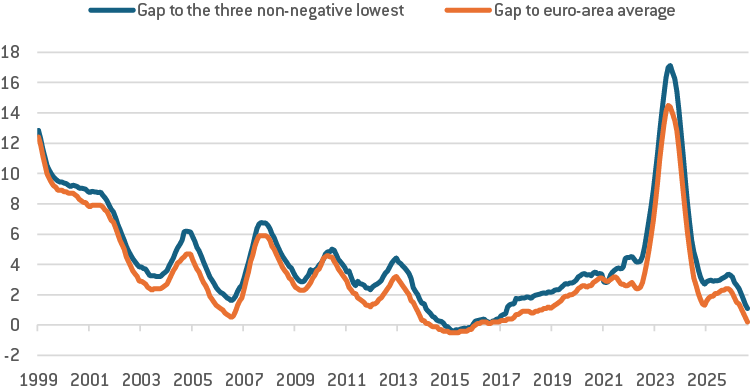
Source: Bruegel based on Eurostat. Note: to approximate the average inflation rate of the three countries that could have been used to calculate the inflation reference value under the adopted interpretation (see appendix A2), we calculated, for each month, the average inflation rate of the three EU countries with the lowest non-negative inflation rates, taking into account the actual EU membership in that month. We excluded countries with negative inflation rates, in line with the standard practice in convergence reports. We made no further exclusions, as the additional exclusions applied by the ECB and the Commission were rather ad hoc; see Darvas (2022). In line with the practice of convergence reports, we use the ‘moving 12 months average rate of change’ HICP indicator for the calculations.
Temporary tax or administered-price measures, used by previous euro applicants, need not be ruled out, but their fiscal cost, duration and reversal effects should be explicit (ECB, 2013). Hungary’s accession strategy should demonstrate that the reference value can be met without relying on an unsustainably strong exchange rate or temporary measures likely to cause a large inflation rebound after entry.
The more immediate policy question is how to combine fiscal adjustment with monetary and exchange-rate policy. Fiscal consolidation, a strong forint and high real interest rates could tighten demand excessively. The government should continue to wind down subsidised and capped-rate credit, which currently weakens monetary transmission (ECB, 2026). As fiscal policy tightens and when inflation expectations permit, the MNB can ease monetary policy without treating forint strength as an objective in itself. Such a policy rebalancing must remain conditional on the inflation outlook and consistent with MNB independence.
After euro adoption, Hungary may have higher inflation than the euro-area average as its income and price levels converge. This happened to several euro-area countries (appendix A2) and some inflation could occur, for example, if productivity in Hungary’s tradable sector grows faster relative to its non-tradable sector than the corresponding productivity differential in euro-area partners (Issing, 2005). This would not be concerning, but inflation should not persistently exceed what productivity convergence can plausibly explain, for example, because wage growth persistently outstrips productivity, fiscal policy overstimulates demand or credit expands too rapidly.
Current judgement
Hungary does not yet pass the inflation credibility test, notwithstanding that it met the Maastricht inflation criterion in July and August 2026 (Figure 2). The immediate task is to establish a policy mix capable of meeting the Maastricht criterion during the eventual 12-month assessment period without an unsustainable exchange rate or excessive demand compression. To this end, wage setting, fiscal policy and credit growth should prevent inflation from persistently exceeding the rate, consistent with productivity-led real appreciation both before and after euro adoption. This, rather than remaining below the Maastricht reference value, will be the relevant measure of Hungary’s capacity to function successfully inside the euro.
3.4 Test 4: productivity, competitiveness and adjustment capacity
Can wages, productivity, fiscal policy and the financial system absorb country-specific shocks once the exchange rate and national monetary policy are no longer available?
In relation to how adjustment would be achieved once national monetary and exchange-rate policies are no longer available, Hungary’s small size, openness, extensive trade with the euro area and widespread use of euro financing already favour euro adoption. However, its adjustment capacity is weaker than it could be because exports are concentrated in the German automotive supply chain. Moreover, the economy depends on imported energy, fiscal space is limited, productivity growth is weak and wages have risen much faster than productivity. Euro adoption may itself deepen trade and financial integration, but that cannot substitute for adequate adjustment capacity at point of entry14.
The wage-productivity gap is the main practical constraint. When wages rise faster than productivity, unit labour costs increase. Outside the euro area, forint depreciation has periodically absorbed part of the resulting competitiveness pressure. Inside it, adjustment would have to occur through higher productivity, lower margins, lower employment or lower nominal wages.
The widening gap has had several causes. High inflation prompted wages to catch up after the loss of purchasing power in 2022-2023. Labour supply has also been constrained by demographic decline, outward migration and skills and geography mismatches. Large minimum wage increases and discretionary public-sector pay measures have added to wage pressure, while weak output and investment growth have held back productivity. These factors have raised unit labour costs even though Hungarian wage levels remain comparatively low.
Future minimum-wage agreements should therefore be reviewed annually against productivity, expected inflation, employment and conditions in exposed sectors, rather than fixed several years in advance. Public-sector settlements should follow the same principles. The closure to new applicants of the guest-worker permit route from June 2026, which is likely to exacerbate domestic labour shortages, should also be reconsidered. Hungary should retain a controlled, needs-based labour-immigration route for sectors that face demonstrated shortages. Measures to improve training, domestic mobility and labour-force participation should also be deployed (European Commission, 2026; OECD, 2026; IMF, 2025).
With Hungary’s income level – 68 percent of the average of eight more-developed EU countries15 in 2025 – prices and inflation could be pushed up, but this is not a given. The mechanism (the so-called Balassa-Samuelson effect; see appendix A3) depends on comparatively strong tradable-sector productivity growth, not on income convergence by itself. With weak aggregate productivity and an appreciated real exchange rate, the policy baseline should allow only a modest structural inflation differential, unless sectoral evidence shows a stronger productivity premium. Nominal appreciation should not be treated as the alternative route to convergence.
Passing the productivity test requires more than labour-market flexibility. Hungary needs fiscal room for automatic stabilisers, a banking system that can absorb a reversal in capital flows, better insolvency and restructuring procedures, more competitive product markets, deeper domestic supply chains and a labour, skills and energy strategy. The government should stress test the economy against a prolonged German industrial slowdown, intensified Chinese competition in EU markets and a disruption to automotive or battery investment.
Current judgement
Hungary’s capacity to absorb shocks is uneven. The large fiscal deficit and high debt-service costs leave limited scope for countercyclical fiscal support. Rapid wage growth alongside weak productivity growth has also put pressure on cost competitiveness, partly offset in recent years by forint depreciation (European Commission, 2026). Banks, by contrast, are well capitalised, although business failures and house-price developments warrant monitoring (OECD, 2026). Before entry, the government should examine how Hungary absorbed the COVID-19 and 2022-2024 energy shocks, identifying the contributions of exchange-rate adjustment, monetary policy and fiscal support. It should then test how comparable shocks would affect employment, wages, public finances and bank balance sheets in the absence of an independent exchange rate or policy rate.
3.5 Test 5: exchange rate, financial resilience and ERM II execution
Can Hungary enter the exchange-rate mechanism at a rate consistent with medium-term competitiveness, while managing the capital flows and balance-sheet changes generated by convergence?
The central exchange rate decision draws on the previous four tests. A stronger fiscal position can reduce the sovereign risk premium, while a credible low-inflation regime can influence the expected path of the nominal exchange rate. The effects of stronger competition, better skills, supplier development and energy efficiency should count only when they are visible in productivity, unit labour costs and export performance. Further gains from reform should be treated as scenarios, not incorporated into the central estimate.
This test has two stages. Before entry into the Exchange Rate Mechanism (ERM II), Hungary should identify a sustainable range for the central exchange rate, conduct financial and fiscal stress tests and assess whether existing macroprudential measures could contain accelerated capital inflows, credit growth or property prices. The authorities should also prepare the operational arrangements for ERM II with European institutions. When participating in ERM II (which Hungary must do for at least two years prior to euro adoption; see Box 1 in the introduction), the test is whether the authorities can maintain exchange rate stability without persistent heavy intervention, prolonged high real interest rates or a loss of competitiveness, while containing any associated build-up of financial risk.
As section 3.3 shows, neither recent appreciation nor comparison with the historical real exchange rate establish the equilibrium rate. Hungary should commission a range of equilibrium estimates, supported by current-account, unit labour cost and sectoral profitability analysis. The work should identify a sustainable exchange-rate range. The methodology should be published, although disclosing a numerical range before agreement with the ERM II parties could invite speculation and constrain the negotiations.
Convergence expectations can compress yields, appreciate the currency and support credit and asset prices. They can also encourage leveraged purchases of Hungarian government bonds and increase the already significant exposure of banks to the sovereign. Among previous euro adopters, there was no common path, so their experiences should inform stress scenarios rather than forecasts for Hungary. Buffers and policy tools should be in place before inflows accelerate16.
Hungary should seek agreement on close cooperation with ECB banking supervision alongside ERM II participation, as did Bulgaria and Croatia (Darvas and Martins, 2022). Preparations should include a comprehensive ECB assessment of significant banks, stress tests, a macroprudential plan and a communications protocol with European institutions.
The ERM II parties might also seek prior commitments on Hungary’s non-bank financial sector, insolvency, anti-money laundering, public-sector governance and the business environment, as they did for Bulgaria and Croatia (Darvas and Martins, 2022).
ERM II itself has no Maastricht-style entry criteria, but participation requires the agreement of the ECB, euro-area finance ministers and ERM II members (currently only Denmark) and may entail country-specific commitments. Separately, Hungary should maintain as domestic safeguards sufficient fiscal and inflation margins to withstand ordinary forecast errors or adverse shocks during the assessment period.
Current judgement
It is too early to identify a credible central exchange rate or ERM II entry date for Hungary. The appropriate exchange rate cannot be inferred from recent appreciation, and a numerical range should not become a political target before the fiscal and inflation regimes have stabilised.
4 Sequencing the adjustment
Hungary’s programme should be organised around milestones rather than a euro-adoption deadline. The sequence below separates measures that establish credibility from those that directly restrain demand. This would reduce the risk that a government tightens fiscal, monetary and exchange-rate conditions simultaneously.
4.1 Phase 1: establish the framework (first 12 months)
- Request an early joint technical roadmap from the Commission and ECB, covering legal compatibility, convergence assessment, ERM II preparation, banking supervision and payment systems.
- Publish an independently costed medium-term fiscal plan based on conservative potential growth and interest-rate assumptions. Include pension commitments, tax exemptions, administered price costs and central bank balance sheet issues.
- Start expenditure, tax expenditure17 and procurement reviews. Freeze new untargeted subsidies and subject major investment incentives to transparent tests of value-added.
- Adopt the core rule of law, judicial, procurement and fiscal governance reforms needed to restore implementation capacity and normalise access to EU funding.
- Remove distortive energy-price controls and subsidised credit to restore market signals, replacing them where necessary with transparent, targeted support for vulnerable households and smaller firms.
- Implementation will require an effective civil service. The government should retain competent career officials whose integrity is not in question, restore merit-based recruitment and pay in specialist functions, and fill remaining gaps through the Hungarian diaspora, EU institutions and temporary secondments.
The first-year objective would be to establish a credible fiscal adjustment path, begin the highest quality savings and prevent new liabilities from being created. The fiscal path should be based on conservative assumptions, because potential growth may remain near one percent, while German industry weakness, EU-China trade tensions or the transition to electric vehicles could undermine exports and foreign investment. Politically difficult measures should be prepared while the government can still distinguish inherited problems from its own policy choices. Delay would compress adjustment into the period before the next election (due in 2030) and increase the risk of pro-cyclical or temporary measures18.
4.2 Phase 2: rotate the policy mix and deliver structural consolidation
- Implement the multi-year fiscal reallocation: reduce low-return economic support and tax privileges, while implementing reforms to improve high-return public services.
- Complete the removal or retargeting of administered price distortions, such as margin caps on selected food and retail products and fuel-price interventions, as well as credit distortions, such as interest-rate caps on retail loans and subsidised lending programmes. While maintaining these distortions may seem to improve inflation outcomes, reversing these measures after entering the euro could lead to a resurgence of inflation or reveal an unsustainable central exchange rate, potentially requiring painful and prolonged adjustment.
- As monetary transmission improves and inflation permits, allow monetary easing to offset part of the fiscal drag, to avoid simultaneously tight fiscal and monetary policies, which might result in an excessively strong forint, weaken domestic firms, crowd-out local suppliers through cheap imports and erode political support before the institutional reforms deliver results.
- Adopt a wage-setting framework tied more closely to productivity and employment, including minimum wages and public-sector settlements.
- Use released EU funds for additional, appraised investment.
- Begin the productivity programme in skills, competition, R&D, energy, transport and local-supplier development. Publish annual result measures rather than expenditure targets alone.
Most of the structural work should be done as part of this phase. Fiscal tightening should be steady enough to lower debt and restore room for automatic stabilisers, but should be calibrated against the exchange rate, real interest rates and the external balance. If domestic demand recovers rapidly and the current-account surplus disappears, the pace should increase. If the forint becomes overvalued and output stalls, monetary and exchange-rate conditions should absorb more of the adjustment, provided inflation remains under control.
4.3 Phase 3: pre-ERM II
ERM II entry should not be rushed. Premature ERM II entry would bind the exchange rate before the fiscal, inflation and productivity reforms needed to support it are sufficiently advanced, and might result in an inappropriate central exchange rate. Ahead of joining ERM II, Hungary should measure itself against our tests 1-4 and the preparatory elements of test 5. The remaining elements of test 5 can only be assessed during the ERM II period: whether the forint remains stable against the agreed central rate without severe tensions, persistent heavy intervention or prolonged high real interest rates, and whether the authorities can manage the associated capital flows and financial risks without undermining competitiveness.
- Demonstrate that the excessive deficit has been corrected, that compliance with the agreed net-expenditure path rests on implemented measures and that debt can be expected to decline under conservative assumptions. Hungary need not have reached the final medium-term deficit before entering ERM II, but should comply with annual adjustment requirements, while measures required to reach it should be legislated and credible.
- Show a sustained inflation record after the main administered price adjustments, and evidence that monetary transmission has normalised.
- Publish the equilibrium exchange rate work and macro-financial stress tests.
- Confirm that banks, fiscal institutions and macroprudential authorities can manage capital inflows and a later reversal.
- Assess political durability, particularly if the final pre-ERM II phase overlaps with the 2030 election19.
Once tests 1–4 and the preparatory elements of test 5 have been satisfied, the government should request entry into ERM II and close cooperation with ECB banking supervision, and seek agreement on the central exchange rate. Any domestic decision not to proceed should identify publicly either a condition that has ceased to be met or a material new risk.
4.4 Phase 4: ERM II and euro adoption
During ERM II, Hungary would retain its own monetary policy, but the exchange-rate commitment would restrict its room for manoeuvre. Fiscal and macroprudential policies would therefore assume greater stabilisation roles. After euro adoption, fiscal policy would become the principal national macroeconomic instrument.
The authorities should avoid pro-cyclical spending financed by convergence-related revenue or lower yields. Macroprudential policy should respond early to credit and property-market pressure. Wage agreements and administered price decisions should be assessed against the inflation reference window.
5 Concluding remarks
Following this four-phase sequence would make it more likely that Hungary can meet the formal criteria without leaving vulnerabilities that re-emerge after entry. Temporary measures may help Hungary meet the inflation criterion, as they have in previous accession cases, but their cost and subsequent reversal should be transparent. Convergence in yields, the exchange rate or headline inflation would otherwise provide a misleading indication of preparedness.
If Hungary were ready to enter ERM II by around 2030, euro adoption in 2032 could be feasible, but this should not be thought of as a target. Progress through the phases should determine the timetable. Premature entry would create substantial risks, but repeated deferral would weaken the government’s European strategy, allow reform momentum to dissipate and reverse the risk premia decline observed after the April 2026 election. Hungary should adopt the euro at the earliest date consistent with durable convergence, as reflected by meeting the five domestic readiness tests proposed in this paper in a convincing and sustainable manner.
References
Backé, P. and S. Dvorsky (2018) ‘Enlargement of the euro area: the road ahead’, Focus on European Economic Integration Q3/18, Oesterreichische Nationalbank, available at https://www.oenb.at/dam/jcr%3Af96da888-8003-4258-ab9a-215cd862d2ec/04_Enlargement of the euro_feei_2018_q3.pdf
Coutinho, L. and A. Turrini (2020) ‘Real convergence across the euro area’, Intereconomics 55(5): 301-311, available at https://doi.org/10.1007/s10272-020-0920-2
Csontos, T.T., A. Éltető, E. Molnár and M. Sass (2026) ‘EV Cluster Hungary? Co-location and co-evolution of German OEMs and Asian EV investors and the transformation of Hungary’s and Europe’s automotive value chains’, Perspektive, Friedrich-Ebert-Stiftung, available at https://real.mtak.hu/246772/1/EVclusterHungary.pdf
Darvas, Z. (2010) ‘The case for reforming euro area entry criteria’, Society and Economy 32(2): 195-219, available at https://doi.org/10.1556/socec.32.2010.2.3
Darvas, Z. (2019) ‘With or without you: are central European countries ready for the euro?’ Policy Contribution 2019/12, Bruegel, available at https://bruegel.org/2019/10/with-or-without-you-are-central-european-countries-ready-for-the-euro/
Darvas, Z. (2022) ‘Discretion lets Croatia in but leaves Bulgaria out of the euro area in 2023’, Bruegel Blog, 22 June, available at https://www.bruegel.org/blog-post/discretion-lets-croatia-leaves-bulgaria-out-euro-area-2023
Darvas, Z. (2026) ‘Hungary has room to streamline public spending without hurting growth’, Analysis 15/2026, Bruegel, available at https://doi.org/10.64153/RBTB4277
Darvas, Z. and C. Martins (2022) Close cooperation for bank supervision: The cases of Bulgaria and Croatia, In-Depth Analysis prepared for the ECON Committee, European Parliament, available at https://www.bruegel.org/report/close-cooperation-bank-supervision-cases-bulgaria-and-croatia
Darvas, Z. and G. Szapáry (2010) ‘Euro-area enlargement and euro adoption strategies’, in M. Buti, S. Deroose, V. Gaspar and J. Nogueira Martins (eds) The Euro: The First Decade, Cambridge University Press, available at http://www.cambridge.org/be/academic/subjects/economics/macroeconomics-and-monetary-economics/euro-first-decade
Darvas, Z., L. Welslau and J. Zettelmeyer (2024) ‘The implications of the European Union’s new fiscal rules’, Policy Brief 10/2024, Bruegel, available at https://www.bruegel.org/policy-brief/implications-european-unions-new-fiscal-rules
Dorrucci, E., M. Fidora, C. Gartner and T. Zumer (2021) ‘The European exchange rate mechanism (ERM II) as a preparatory phase on the path towards euro adoption—the cases of Bulgaria and Croatia’, ECB Economic Bulletin 8/2020, European Central Bank, available at https://www.ecb.europa.eu/press/economic-bulletin/articles/2021/html/ecb.ebart202008_01~035eb0fb07.en.html
ECB (2006) Convergence Report, May, European Central Bank, available at https://www.ecb.europa.eu/pub/pdf/conrep/cr2006en.pdf
ECB (2008) Convergence Report, May, European Central Bank, available at https://www.ecb.europa.eu/pub/pdf/conrep/cr200805en.pdf
ECB (2010) Convergence Report, May, European Central Bank, available https://www.ecb.europa.eu/pub/pdf/conrep/cr201005en.pdf
ECB (2013) Convergence Report, June, European Central Bank, available at https://www.ecb.europa.eu/pub/pdf/conrep/cr201306en.pdf
ECB (2026) Convergence Report, June, European Central Bank, available at https://www.ecb.europa.eu/press/other-publications/convergence/html/ecb.cr202606~30e75ae1c2.en.html
European Commission (2025) ‘In-Depth Review for Hungary’, Institutional Paper 312, Directorate-General for Economic and Financial Affairs, available at https://economy-finance.ec.europa.eu/publications/depth-review-2025-hungary_en
European Commission (2026) ‘Convergence Report 2026’, Institutional Paper 343, Directorate-General for Economic and Financial Affairs, available at https://economy-finance.ec.europa.eu/publications/convergence-report-2026_en
Falagiarda, M. and C. Gartner (2022) ‘Croatia adopts the euro’, ECB Economic Bulletin 8/2022, European Central Bank, available at https://www.ecb.europa.eu/press/economic-bulletin/focus/2023/html/ecb.ebbox202208_02~15fd36600a.en.html
Frankel, J.A. and A.K. Rose (1998) ‘The endogeneity of the optimum currency area criteria’, Economic Journal 108(449): 1009–1025, available at https://doi.org/10.1111/1468-0297.00327
Giavazzi, F. and M. Pagano (1988) ‘The advantage of tying one’s hands: EMS discipline and central bank credibility’, European Economic Review 32(5): 1055–1075, available at https://doi.org/10.1016/0014-2921(88)90065-7
Győrffy, D. (2024) ‘Liberal and illiberal industrial policy in the EU: the political economy of building the EV battery value chain in Sweden and Hungary’, Comparative European Politics 22: 574-592, available at https://doi.org/10.1057/s41295-023-00374-0
IMF (2025) ‘Hungary: 2025 Article IV Consultation’, IMF Country Report 25/250, International Monetary Fund, available at https://www.imf.org/-/media/files/publications/cr/2025/english/1hunea2025001-source-pdf.pdf
IMF (2026) World Economic Outlook: Resilience Under Strain, Urgent Choices, International Monetary Fund, available at https://www.imf.org/en/publications/weo/issues/2026/10/13/world-economic-outlook-october-2026
Issing, O. (2005) ‘EU Enlargement and Monetary Integration’, in C. Detken, V. Gaspar and G. Noblet (eds), The New EU Member States: Convergence and Stability, European Central Bank, available at https://www.ecb.europa.eu/pub/pdf/other/neweumemberstatesen2005en.pdf
Kratz, A., A. Mischer, G. Williams and A. Meyer (2025) Chinese investment rises to a seven-year high: Chinese FDI in Europe 2025 update, Rhodium Group and MERICS, available at https://merics.org/en/report/chinese-investment-rises-7-year-high-chinese-fdi-europe-2025-update
Lehmann, A. (2018) ‘Criteria for entry into ERM II and banking union: a precedent for Bulgaria’, Bruegel Blog, 29 August, available at https://www.bruegel.org/blog-post/criteria-entry-ermii-and-banking-union-precedent-bulgaria
McKinnon, R.I. (1963) ‘Optimum currency areas’, American Economic Review 53(4): 717–725, available at https://www.jstor.org/stable/1811021
Mundell, R.A. (1961) ‘A theory of optimum currency areas’, American Economic Review 51(4): 657–665, available at https://www.jstor.org/stable/1812792
OECD (2026) OECD Economic Surveys: Hungary 2026, Organisation for Economic Co-operation and Development, available at https://doi.org/10.1787/1d93d51d-en
Pench, L. (2024) ‘Three risks that must be addressed for new European Union fiscal rules to succeed’, Policy Brief 08/2024, Bruegel, available at https://www.bruegel.org/policy-brief/three-risks-must-be-addressed-new-european-union-fiscal-rules-succeed
Pierluigi, B. and D. Sondermann (2018) ‘Macroeconomic imbalances in the euro area: where do we stand?’ Occasional Paper 211, European Central Bank, available at https://www.ecb.europa.eu/pub/pdf/scpops/ecb.op211.en.pdf
Potton, E. and A. Mellows-Facer (2003) ‘The euro: background to the five economic tests’, Research Paper 03/53, House of Commons, available at https://commonslibrary.parliament.uk/research-briefings/rp03-53/
Szapáry, G. (2000) ‘Maastricht and the Choice of Exchange Rate Regime in Transition Countries During the Run-Up to EMU’, NBH Working Paper 2000/07, National Bank of Hungary, available at https://dx.doi.org/10.2139/ssrn.254314
Appendix: Inflation convergence and Balassa-Samuelson
A1 Lessons from selected euro adopters
The experience of previous euro adopters illustrates why meeting the 12-month Maastricht inflation criterion must be distinguished from managing inflation after adoption. The criterion does not require inflation subsequently to remain below the reference value or to match the euro-area average. The relevant question is whether later inflation and real appreciation reflect productivity convergence or unsustainable wage, credit and fiscal pressures. The cases in Table A1 illustrate why the distinction matters.
Table A1: Euro adoption, selected examples
| Entrant | Before entry | After entry | Lesson for Hungary |
| Slovenia, 2007 | Inflation was 2.5% in 2006. Disinflation reflected the monetary framework and ERM II stability, but the ECB warned of credit, administered price and wage pressures. | Inflation reached 3.8% in 2007 and 5.5% in 2008. Food, energy and domestic pressures complicate attribution to euro entry. | Meeting the criterion does not settle what happens as interest rates and credit conditions converge. |
| Slovakia, 2009 | Inflation was 1.9% in 2007 and 3.9% in 2008. Koruna appreciation restrained import prices; the central parity was revalued twice. | Inflation was 0.9% in recession-hit 2009 and 4.1% in 2011. The decline in 2009 does not validate any particular parity. | Assess the conversion rate against tradables profitability and wages, not the inflation reading alone. |
| Estonia, 2011 | The 12-month inflation rate used for assessment was −0.7%, amid a severe downturn. Annual average inflation was 2.7% in 2010. | Annual average inflation was 5.1% in 2011 and 4.2% in 2012, but aggregate inflation rates alone provide no evidence of a Balassa-Samuelson effect. | Distinguish recession-driven disinflation from a policy mix that remains sound when growth resumes. |
| Croatia 2023 | In April 2022, 12-month average HICP inflation was 4.7%, below the 4.9% reference value calculated after Malta and Portugal were excluded as outliers. Croatia exceeded even this adjusted benchmark in May 2022 and inflation and its gap to the euro-area average continued to rise until April 2023. | Since joining the euro in January 2023, Croatian inflation has exceeded the euro-area average by 2.3 percentage points on average. Energy, food and domestic pressures make attribution to euro adoption difficult. | The exclusions illustrate the discretion involved in identifying the best-performing countries. Temporary inflation-reducing measures were acknowledged but did not alter the assessment of ‘convergence’. |
| Bulgaria 2026 | Bulgaria operated a currency board with the lev fixed to the euro since 1999. It entered ERM II and close cooperation with ECB Banking Supervision in 2020 and completed an agreed reform programme. Its 12-month average inflation was 2.7% in April 2025, just below the 2.8% reference value. | Bulgaria’s inflation differential with the euro area widened to 1.6 percentage points by July 2026. | The currency board offers little guidance on Hungary’s parity. Its experience shows that ERM II and banking supervision can anchor broader reforms, but meeting the inflation criterion does not ensure that the inflation differential will remain unchanged. |
| Spain and Ireland, 1999 | Falling interest rates preceded the subsequent accumulation of credit and property market imbalances. | Abundant credit supported housing and domestic demand; the eventual adjustment was severe. Spain also experienced a prolonged loss of cost competitiveness. | Do not mistake real appreciation driven by credit and unit labour costs for productivity-led convergence. |
Source: Bruegel based on ECB (2006) for Slovenia, ECB (2008) for Slovakia, ECB (2010) for Estonia, Pierluigi and Sondermann (2018) for Spain and Ireland.
Earlier entrants offer no simple formula for setting Hungary’s conversion rate. The common lesson is that the source of real appreciation matters: productivity-led appreciation may accompany sustainable catch-up, whereas appreciation driven by domestic costs or credit can weaken competitiveness, even if Hungary meets the inflation criterion at entry.
A2 Why the current interpretation of the Maastricht inflation criterion is not a post-entry benchmark
The Maastricht inflation criterion is an entry condition, not a continuing obligation after euro adoption. This appendix demonstrates that, under the interpretation applied in the convergence reports, a substantial share of euro-area countries would have breached the criterion had compliance been required on an ongoing basis after adopting the euro. This finding is consistent with the use of temporary inflation-reducing measures prior to euro adoption, a behaviour that Szapáry (2000) termed the “weighing-in syndrome”20.
Under Article 140(1) and Protocol No 13 of the TFEU (see footnote 2), an applicant’s 12-month average inflation rate must not exceed by more than 1.5 percentage points that of the “three best-performing Member States in terms of price stability”. The Treaty does not define ‘best-performing,’ and the Commission and ECB have interpreted this as the three EU countries with the lowest inflation rates, while also exercised discretion when excluding countries considered outliers (Darvas, 2022). Thus, the ECB adopts different definitions of price stability when setting the entry requirement into the euro area and when defining its monetary policy objective, for which price stability is defined as inflation at 2 percent over the medium term.
Our calculations apply a consistent hypothetical reference value from January 1999 to August 2026 rather than attempting to reproduce discretionary exclusion of some low-inflation countries, as was done in several official assessments. However, negative inflation countries were often excluded and thus we also exclude them. Figure A1 compares the resulting three-country average with euro-area inflation.
Figure A1: Euro-area inflation and the average inflation rates of the three EU countries with the lowest non-negative inflation rates, January 1999 - August 2026 (percent)

Source: Bruegel based on Eurostat’s Harmonised Index of Consumer Prices. Note: the hypothetical reference value would be the unweighted average of the three lowest non-negative 12-month average HICP inflation rates among EU members (red line), plus 1.5 percentage points. No additional discretionary exclusions are made. The sample reflects EU membership in each month.
Euro-area members frequently recorded inflation above the hypothetical reference value, which adds 1.5 percentage points to the average of the three EU countries with the lowest non-negative inflation rates (Figure A2). On average, 33 percent of members were above it over the full period, rising to 41 percent in months when no EU country had negative inflation. Ten of the 21 euro-area countries were above it in July and August 2026.
Such widespread non-compliance highlights the arbitrary nature of defining the benchmark in terms of the three lowest inflation rates. Darvas (2010) showed that, if a similar criterion were applied to United States metropolitan areas, roughly half would have failed to comply when the benchmark was based on the three lowest non-negative inflation rates. He therefore proposed defining the EU’s benchmark as the average inflation rate of the three countries closest to the euro-area average and assessing compliance over a period longer than one year. The rationale is that euro-area inflation reflects the inflation outcome that a price-stability-oriented ECB can achieve under prevailing macroeconomic conditions, while a longer assessment horizon would provide a better test of durable price stability. For the US, using average US inflation as the benchmark, the corresponding non-compliance rate would have been only 11 percent from 1916 to 2009 and four percent from 1990 to 2009, suggesting that such a criterion would have been broadly consistent with normal regional inflation differentials, while still preserving a meaningful price-stability requirement.
As long as the EU inflation criterion continues to be based on the three lowest-inflation member states, temporary measures aimed at meeting the criterion during the 12-month pre-entry assessment period, followed by deviations after euro adoption, are not in themselves a major concern. Once a country has adopted the euro, more relevant is whether a country’s inflation exceeds the euro-area average because of benign factors, such as faster productivity growth and real convergence, or because of unsustainable drivers, including excessive wage growth relative to productivity, or overly expansionary credit and fiscal policies.
Figure A2: Euro-area countries above a hypothetical Maastricht inflation reference value, January 1999 - August 2026 (number of countries)

Source: Bruegel; see Figure A1. Note: the figure counts members of the euro area in each month in which 12-month average HICP inflation exceeded the hypothetical reference value defined in Figure A1. The few months in which all euro-area countries met the inflation criterion coincided with periods when some countries with negative inflation rates were excluded from the group of ‘best performers’. The maximum number of countries with negative inflation rates was 14 in November 2015; thus, the reference value in that month was based on the three countries with the lowest inflation rates among the remaining 14 EU members.
A3 Four checks for Hungary
These checks assess whether Hungary has displayed the productivity, wage and relative-price patterns associated with the Balassa-Samuelson effect over the past two decades, and whether recent trends support expecting productivity-led real appreciation after euro adoption. The mechanism requires Hungary’s productivity differential between tradable and non-tradable sectors to exceed the corresponding differential among its euro-area partners.
Manufacturing is used as a proxy for tradable production, while construction, trade and other services represent predominantly local sectors. These classifications are imperfect. The exercise is not designed to explain Hungary’s short-term inflation fluctuations21.
Table A2: Four checks for Hungary
| Check | Evidence | Interpretation |
| Relative sector productivity | Hungary’s manufacturing-minus-local productivity gap exceeded the EA20 gap by 2.5 percentage points a year in 2001-08 but fell short by 2.6 percentage points in 2011-19 and by 1.1 percentage points in 2022-24. | Only the early period fits the Balassa-Samuelson pattern. Recent productivity does not support an allowance for productivity-led inflation. |
| Wage transmission | In 2001-08, productivity grew by 7.1% per year in manufacturing and 2.7% in local sectors, while real wages grew by about 4% in both. In 2011-19, productivity growth was 0.8% in manufacturing and 2.5% locally, while real wages grew by 1.7% in manufacturing and fell by 0.5% locally. In 2022-24, real wages slightly outpaced productivity in both groups. | Only the first period resembles Balassa-Samuelson wage transmission. Since 2011, wage developments have not been associated with superior manufacturing productivity. |
| Local service prices | Services inflation exceeded inflation in non-energy industrial goods by an average of 4.4 percentage points a year in 2002-08, 1.8 points in 2011-19 and 3.7 points in 2022-24. | Relative service price increases are persistent. They are consistent with, but not proof of, a Balassa-Samuelson effect. |
| Alternative explanations for inflation | Hungarian HICP inflation exceeded the EA20 rate by 11.6 percentage points in 2023 and 1.3 percentage points in 2024. | The size and timing of the gap are inconsistent with a productivity explanation alone. Energy, food, demand, administered prices and the exchange rate must be assessed separately. |
Source: Bruegel based on Eurostat national accounts. Note: EA20 = euro-area countries except Bulgaria. Manufacturing is NACE C. The local-sector proxy comprises construction (F), trade, transport and accommodation (G–I), and arts, personal and other services (R–U). Productivity is real gross value added per hour worked. Real wages are wages and salaries per employee-hour, deflated by all-items HICP. Period growth rates include the change in the first year shown, calculated from the preceding year. The relative-productivity measure is Hungary’s manufacturing-minus-local differential less the corresponding EA20 differential. Inflation gaps are based on annual-average HICP inflation.
Hungary’s income gap leaves scope for productivity-led real convergence after euro adoption. However, the sectoral evidence does not suggest a Balassa-Samuelson effect in Hungary since the global financial crisis. Since 2011, manufacturing productivity has not outpaced local sector productivity relative to the corresponding euro-area differential. What matters is whether the reforms the new government aims to implement actually raise productivity in Hungary’s tradable sector relative to local sectors and euro-area partners. Any allowance for Balassa-Samuelson inflation should be based on gains already visible in the data, not assumed in advance.
Authors


Gene Frieda
Bruegel Non-resident Fellow
Related content

What would make Hungary ready for the euro?
How could Hungary streamline public spending without undermining growth?

Hungary has room to streamline public spending without hurting growth
Cutting some state operating and economic spending to the average of its regional peers could save Hungary more than four percent of GDP

Where Hungary’s money went — and where a Tisza government could move
Endnotes
- 1
Reuters, ‘Hungary aims to meet euro entry conditions by around 2030, PM Magyar says’, 26 June 2026, https://www.reuters.com/world/hungary-aims-meet-euro-entry-conditions-by-around-2030-pm-magyar-says-2026-06-26/.
- 2
See https://eur-lex.europa.eu/eli/treaty/tfeu_2016/art_140/oj/eng and https://eur-lex.europa.eu/eli/treaty/tfeu_2016/pro_13/oj/eng.
- 3
See European Commission, ‘Convergence Reports’, https://economy-finance.ec.europa.eu/euro/enlargement-euro-area/convergence-reports_en and European Central Bank, ‘Convergence Report’, https://www.ecb.europa.eu/press/other-publications/convergence/html/index.en.html.
- 4
Authors’ calculations based on European Commission AMECO series RVGDE (real GDP per person employed), spring 2026 vintage. Period figures are average annual growth rates.
- 5
See Balazs Égert, ‘Hungary’s growth model worked until it didn’t’, The Economic Hitchhiker, 21 May 2026, https://econhitchhiker.substack.com/p/hungarys-growth-model-worked-until.
- 6
The REER’s position relative to its own history, which spans different policy regimes, does not measure equilibrium valuation.
- 7
Real effective exchange rate indices, which are expressed relative to a base year set equal to 100, indicate whether a currency has appreciated or depreciated in real terms over time. However, they do not reveal whether a currency is overvalued or undervalued, as the index itself has no natural level interpretation. In contrast, the relative price level between two countries, as plotted in Figure 1, has a natural level interpretation: the average ratio of domestic to foreign prices. Real exchange rate appreciation is reflected in an increase in the relative price level, as well as in the increase in the real effective exchange rate. Figure 1 shows a strong association between relative GDP per capita and relative price levels, both across countries in a given year and over time for a given country.
- 8
See European Commission statement of 29 May 2026, ‘Statement by President von der Leyen with Hungarian Prime Minister Magyar’, https://ec.europa.eu/commission/presscorner/detail/en/statement_26_1200.
- 9
See also Lehmann (2018) and Darvas and Martins (2022) on the enhanced pre-entry process established in the Bulgarian case.
- 10
See Hungarian National Assembly, ‘Költségvetési Tanács’, https://www.parlament.hu/web/koltsegvetesi-tanacs/in-english.
- 11
The one percent to 1.5 percent deficit range is authors’ calculations based on updated macroeconomic and financial data, using the code developed by Lennard Welslau, which is available at https://github.com/lennardwelslau/eu-debt-sustainability-analysis. The Commission’s 2024 reference trajectory for Hungary implied a smaller medium-term overall deficit target. See Darvas et al (2024) for the requirements of the new EU fiscal framework and Pench (2024) for the unresolved interaction between deficit- and debt-based excessive-deficit procedures.
- 12
Reuters, ‘Hungary government proposes wealth tax on ultra-rich’, 6 October 2026, https://www.reuters.com/business/hungary-government-proposes-wealth-tax-ultra-rich-2026-10-06/.
- 13
Pension adequacy, particularly for people with very low entitlements, should be addressed directly as part of a wider reform of pension financing and retirement incentives.
- 14
Mundell (1961), McKinnon (1963), Frankel and Rose (1998). The last contribution is especially relevant to the possibility that trade and business-cycle synchronisation may increase after membership.
- 15
Using data on GDP per capita at purchasing power standards from Eurostat; see the note to Figure 1.
- 16
See Dorrucci et al (2021), Backé and Dvorsky (2018) and Coutinho and Turrini (2020). Croatia’s experience is discussed in Falagiarda and Gartner (2022).
- 17
Tax expenditures refer to losses in government revenue caused by specific tax provisions, including exclusions, exemptions, deductions, credits, deferrals and preferential rates, which lessen the tax burden on particular groups of taxpayers or activities.
- 18
Poland’s experience since a new government took office in December 2023, following on from a government that was in some ways similar to that of Viktor Orbán’s in Hungary, illustrates this political risk. The Polish government inherited a budget deficit of 5.2 percent of GDP. It postponed consolidation rather than undertaking politically difficult fiscal adjustment early in its term, when responsibility could have been attributed to the previous government. In fact, the deficit increased further to 7.3 percent of GDP in 2025 and is projected at 7.2 percent of GDP in 2026, ahead of the 2027 election when fiscal adjustment might prove difficult. Deficit numbers are taken from IMF (2026).
- 19
A change in government after Hungary’s next election in 2030 could pose a risk to the euro-adoption strategy, as the new leadership may oppose euro adoption. To minimise the risk of reform measures being reversed in such a scenario, we recommend honest and transparent economic and social policies, and communication that explains how the measures needed to introduce the euro would also benefit Hungary, even if ultimately it does not adopt the single currency.
- 20
Szapáry (2000) likened this behaviour to that of a boxer who drastically restricts food intake before a weigh-in but resumes normal eating immediately thereafter. By the same logic, a candidate country may maintain an excessively restrictive monetary stance and employ temporary inflation-suppressing measures, such as freezing administered prices or reducing consumption taxes, in order to meet the Maastricht inflation criterion, only to reverse course once euro adoption has been secured.
- 21
Authors’ calculations based on Eurostat national accounts, HICP and FIGARO data, accessed September 2026.